
Uncategorized

Parental Burnout in Autism Care: Why Taking Breaks is a Necessity, Not Selfishness

A caregiver or parent caring for a child or individual with autism requires a deep sense of advocacy, care, commitment, love, and ultimately sacrifice. Parents often become the child’s or individual’s advocate, care coordinator, teacher, therapists, and emotional anchor. There are sometimes where the parent or caregiver has to switch their roles throughout the day […]

Parental Burnout in Autism Care: Why Taking Breaks is a Necessity, Not Selfishness Read More »

Verity’s Summer Camp: Skill Development by Age Group

SIGN UP TODAY Age Group 1: Early Explorers (Ages 2-5) This group focuses on foundational skills through sensory engagement, imaginative play, and guided social interactions. The “1:1-1:5 Social Enrichment Track” and “1:2-1:3 Moderate Support” levels would be particularly relevant for this age group. Themes Connection: “Animal Explorers,” “Trip Around the Universe” (sensory focus), “Move to

Verity’s Summer Camp: Skill Development by Age Group Read More »

Discovery Day

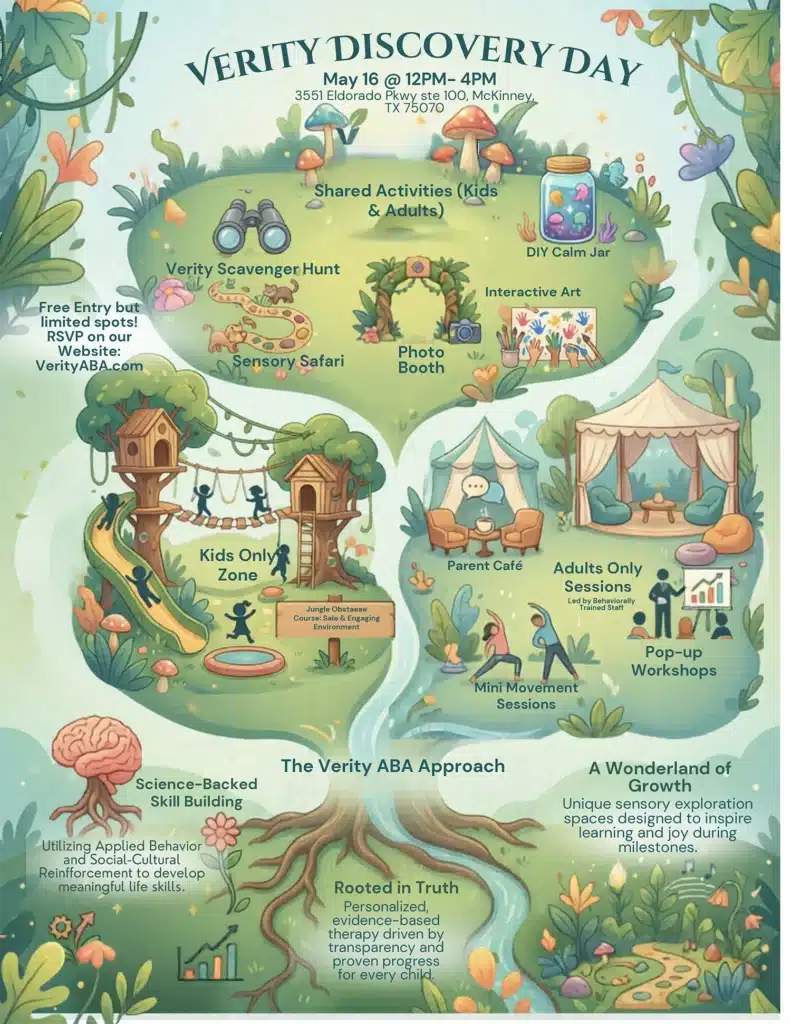
RSVP TODAY Starlight Retreat Experience calming vibes with soothing sounds in our Starlight Retreat sensory room. Find your moment of zen. DIY Calm Jar Make and take home your own glittery, beaded, or scented stress reliever! Shake up some calm. Interactive Art Piece Add your creative touch to our collaborative masterpiece! Leave your colorful mark.

Discovery Day Read More »

Preventing Elopement While Creating and Establishing Safety: An ABA Perspective

There are times when a child or even a best friend may engage in elopement while you are out completing simple tasks. You may think to yourself, “Why did they just leave or escape without telling you where they are going?’” The layman’s terminology for elopement is called wandering, bolting, or running off, and it

Preventing Elopement While Creating and Establishing Safety: An ABA Perspective Read More »

Supporting Big Emotions: Teaching Emotional Regulation Through Mindfulness and Coping Skills (An ABA Perspective)

Emotional regulation is a critical developmental skill that influences a child’s ability to navigate through difficult situations, such as social situations, frustration tolerance, and engagement in successful learning in environments. However, for many children and individuals, specifically those receiving Applied Behavioral Analysis (ABA) therapy, this is a skill that is difficult for them. Some individuals

Supporting Big Emotions: Teaching Emotional Regulation Through Mindfulness and Coping Skills (An ABA Perspective) Read More »

Why Nighttime Routines Matter More Than You Think: Looking at it from an ABA Perspective

For many families, particularly those raising neurodivergent children (e.g., children diagnosed with autism spectrum disorder (ASD), attention-deficit/hyperactivity disorder (ADHD), or other developmental disorders), bedtime can feel overwhelming. What should be a routine often becomes the most challenging adaptive daily living skill of the day. Parents frequently report that getting their child to bed takes hours

Why Nighttime Routines Matter More Than You Think: Looking at it from an ABA Perspective Read More »

Mindfulness and Breathing

Mindfulness and breathing practices are gaining recognition for their potential benefits in children with Autism Spectrum Disorder (ASD).1 Academic research, including systematic reviews and meta-analyses, suggests positive outcomes for both children with ASD and their parents/caregivers.2 Benefits for Children with ASD: ● Improved Social Responsiveness: Mindfulness-based interventions (MBIs) have been shown to significantly improve social

Mindfulness and Breathing Read More »

What is ABA?

Applied Behavior Analysis (ABA) is a science-based approach to understanding and improving meaningful behaviors. It involves observing behavior, identifying the reasons behind it, and using positive, evidence-based strategies to teach new skills, reduce challenging behaviors, and promote independence. ABA is widely recognized as an effective treatment for individuals with autism and other developmental differences. ABA

What is ABA? Read More »

Trauma Informed Care

What is Trauma-Informed Care in ABA? Trauma-informed care is an approach for providing therapeutic support that includes an understanding of and responsiveness to the emotional, physical, psychological and behavioral impact of trauma. It recognizes that many of the clients and families we serve and/or interact with have a history of and/or ongoing trauma that influences

Trauma Informed Care Read More »