

Emotional regulation is a critical developmental skill that influences a child’s ability to navigate through difficult situations, such as social situations, frustration tolerance, and engagement in successful learning in environments. However, for many children and individuals, specifically those receiving Applied Behavioral Analysis (ABA) therapy, this is a skill that is difficult for them. Some individuals have difficulty engaging in emotional regulation, which can lead to difficulty handling and coping with their emotions and behaviors, such as aggression (i.e., physical or verbal aggression), off-task behaviors, or tantrums. One must not view these behaviors simply as problematic; rather, through an ABA perspective, it emphasizes understanding the function of the behavior and teaching appropriate alternative or replacement behaviors that allow the individual to manage their emotional experiences more efficiently. Through structured ABA sessions, it can effectively enhance emotional and social development (Geng et al., 2024).
Recent research has shown that integrating mindfulness-based strategies and coping skill instruction into behavioral interventions benefits mindfulness training. Through mindfulness interventions, it has helped children with autism spectrum disorder (ASD), leading to significant compliance and positive effects on mindful parenting and overall stress reduction (Ho et al., 2021).
Understanding Emotional Regulation in ABA
Emotional regulation skill development should be focused on in ABA therapy. Through emotional regulation, it focuses on monitoring, evaluating, and modifying emotional reactions to support adaptive functioning (Gross, 2015). Through ABA, dysregulated behaviors can be understood as behaviors that have developed to serve a function, such as escape from demands, accessing attention, or denied access to a preferred tangible.
When an individual lacks appropriate communication skills, challenging behaviors help them efficiently meet their needs (Hanley et al., 2014). Targeting emotional regulation in conjunction with communication, executive functioning, and social skills will lead to consistent improvements (Adelson et al., 2024). A child who may become overwhelmed may cry or engage in physical aggression (e.g., hitting) if they have not learned to communicate functionally by requesting a break.
From a behavioral perspective, emotional regulation skills are learned behaviors that require teaching through modeling, prompting, reinforcement, and structured practice. In ABA, emotional regulation interventions will need to place heavy emphasis on targeting both understanding the emotion and teaching the appropriate alternative behavior.
The Role of Emotional Awareness
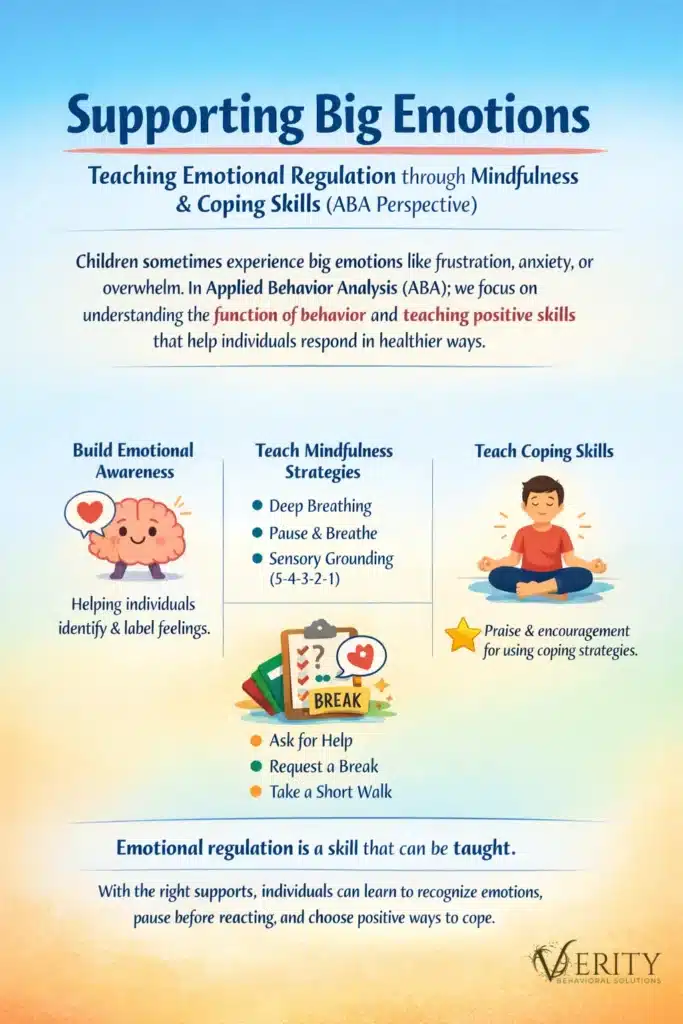
Before an individual can regulate their emotions, they must recognize them. Emotional awareness involves identifying internal states and pairing them with language and behavioral responses. Research has demonstrated that ABA interventions can target “identifying emotion” as a behavioral goal (Esposito et al., 2025), by teaching an individual to expressively label feelings such as disappointment, excitement, or frustration, thereby allowing them to develop their understanding of their emotional experiences.
Common ABA strategies used for teaching emotional recognition:
- Modeling language, such as “It looks like you are feeling frustrated. Let us take a break.”
- Pairing emotions with bodily sensations
- Social stories that describe emotional situations.
- Visual emotion charts, visual emotional wheels, or feeling thermometers.
Mindfulness as a Regulation Strategy
Mindfulness practices have begun to increase attention as an effective tool for improving emotional regulation. Mindfulness requires intentionally bringing attention to the present moment and alleviating psychological distress, reducing behavioral problems, and enhancing cognitive and social skills (Simione et al., 2024).
For individuals receiving behavioral interventions, mindfulness strategies can help create a gap between emotional arousal and the behavioral response. Some types of developmentally appropriate mindfulness strategies include:
Deep Breathing
Deep breathing exercises activate the parasympathetic nervous system, helping the body relax and slow the heart rate during moments of stress. Teaching individuals how to take meaningful, deep breaths allows them to slow their breathing and reduce their physiological arousal that is associated with anxiety or frustration.
Therapy may use a visual prompt, such as:
- Breathing along with a visual cue
- Counting breaths
- Rainbow visual paired with inhale and exhale
- “Smell the flower, blow out the candle.”
Grounding Through the Five Senses
Ground exercises are very beneficial for redirecting attention from overwhelming emotions, allowing the individual to focus on sensory experiences in the environment.
An individual may be guided to identify senses through the 5-4-3-2-1 technique:
- Five things that you see.
- Four things that you can touch.
- Three things that you can hear.
- Two things that you can smell.
- One thing that you can taste.
Grounding through the five senses helps to encourage attentional regulation and reduce emotional escalation.
Mindful Pausing
When teaching an individual to take 3 seconds before reacting, it supports impulse control and self-management. To support this, the behavioral interventions may include prompts such as “Pause and breathe” before responding to the situation.
Teaching Coping Skills as Replacement Behaviors
In ABA, emotional regulation strategies can serve as replacement behaviors for maladaptive behaviors. Rather than engaging in aggression or vocal protest, the individual is taught an alternative response that serves the same underlying function.
Examples of coping-based replacement behaviors include:
- Asking for help.
- Engaging in a brief break.
- Taking a walk.
- Using problem-solving statements.
Reinforcing Emotional Regulation
Reinforcement is required to strengthen emotional regulation behaviors. As the individual appropriately uses the coping strategy, they should receive immediate descriptive reinforcement.
Some examples of the immediate and specific reinforcement include:
- Access to preferred activities.
- Descriptive behavior specific praise, such as “Awesome, taking those deep breaths.”
- Social recognition and encouragement.
There will need to be consistent reinforcement to allow the positive reinforcement to continue to use the strategy in future situations when paired with the emotion.
Conclusion
Emotional regulation is a foundational life skill that requires learning, relationships, and overall well-being. Someone can approach emotional regulation by teaching functional skills that help the individual recognize emotions, pause before reacting, and implement coping strategies.
Teaching the skills will allow the individual to continue building resilience and the emotional awareness needed to thrive across settings.
References
Adelson, R. P., Ciobanu, M., Garikipati, A., Castell, N. J., Barnes, G., Tawara, K., Singh, N. P., Rumph, J., Mao, Q., Vaish, A., & Das, R. (2024). Family-centric applied behavior analysis promotes sustained treatment utilization and attainment of patient goals. Curēus (Palo Alto, CA), 16(6), e62377. https://doi.org/10.7759/cureus.62377
Du, G., Guo, Y., & Xu, W. (2024). The effectiveness of applied behavior analysis program training on enhancing autistic children’s emotional-social skills. BMC Psychology, 12(1), 568-10. https://doi.org/10.1186/s40359-024-02045-5
Esposito, M., Fadda, R., Ricciardi, O., Mirizzi, P., Mazza, M., & Valenti, M. (2025). Ins and outs of applied behavior analysis (ABA) intervention in promoting social communicative abilities and theory of mind in children and adolescents with ASD: A systematic review. Behavioral Sciences, 15(6), 814. https://doi.org/10.3390/bs15060814
Gross, J. J. (2015). Emotion regulation: Current status and future prospects.Psychological Inquiry, 26(1), 1-26. https://doi.org/10.1080/1047840X.2014.940781
Hanley, G. P., Jin, C. S., Vanselow, N. R., & Hanratty, L. A. (2014). Producing meaningful improvements in problem behavior of children with autism via synthesized analyses and treatments. Journal of Applied Behavior Analysis, 47(1), 16-36. https://doi.org/10.1002/jaba.106
Ho, R. Y. F., Zhang, D., Chan, S. K. C., Gao, T. T., Lee, E. K. P., Lo, H. H. M., Au Yeung, P., Lai, K. Y. C., Bögels, S. M., de Bruin, E. I., & Wong, S. Y. S. (2021). Brief report: Mindfulness training for chinese adolescents with autism spectrum disorder and their parents in hong kong. Journal of Autism and Developmental Disorders, 51(11), 4147-4159. https://doi.org/10.1007/s10803-020-04729-4
Simione, L., Frolli, A., Sciattella, F., & Chiarella, S. G. (2024). Mindfulness-based interventions for people with autism spectrum disorder: A systematic literature review.Brain Sciences, 14(10), 1001. https://doi.org/10.3390/brainsci14101001